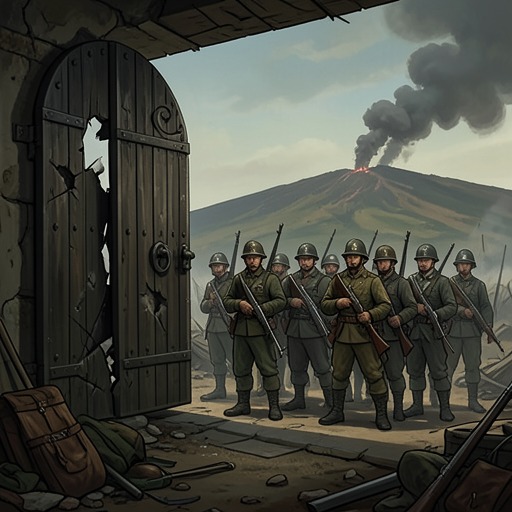
Fall of Jingzhou
The Romance of the Three KingdomsThe Fall of Jingzhou marks the destruction of Guan Yu’s position while he is campaigning against Fancheng. The crisis unfolds on two fronts: Xu Huang’s forces dismantle the outlying camps that protect his communications, while Lü Meng’s seizure of Jingzhou deprives him of his home base and family. Guan Yu initially rejects the news, then discovers that the territory and his support network have already slipped away. The defeat drives him toward Maicheng, precedes his death, and reaches Xuande as a call for vengeance.
Causes and Strategic Position
The danger gathers around Guan Yu’s extended defensive line. Guan Ping is stationed at Yancheng, Liao Hua at Sizhong, and twelve forts connect their positions. Xu Huang exploits that arrangement by using soldiers bearing his colours to mislead Guan Ping, while he takes five hundred elite troops toward Yancheng from the opposite direction. The stratagem draws Guan Ping out and puts the network’s communications and mutual support at risk.
At the same time, Lü Meng has taken Jingzhou, shifting the balance behind Guan Yu’s lines. Cao Cao advances on Fancheng, and Xu Huang’s operations against Guan Ping and Liao Hua add pressure from the north. The eventual reports therefore describe not a single lost engagement but the simultaneous breakdown of the camps, the territorial base, and the routes by which Guan Yu might retreat or obtain help.
The Collapse of the Camps
The deception at Yancheng succeeds: Guan Ping is lured out, and Xu Huang confronts him as flames rise from the camp. Xu Huang also tells him that Jingzhou has fallen to Wu. Guan Ping reaches Sizhong, where Liao Hua asks whether the report is true. Guan Ping dismisses it as a false rumor and threatens those who repeat it, but news arrives that Xu Huang is attacking the northern camp. Guan Ping leaves Liao Hua to hold Sizhong and goes to relieve the threatened position.
The northern camp appears empty when Guan Ping arrives at night. Xu Shang and Lü Jian then spring an ambush, forcing him and his men to retreat with heavy losses. On the way back, Guan Ping and Liao Hua find Sizhong in flames and under Wei control. They escape and return to Guan Yu, carrying news of the lost camps, Cao Cao’s advance on Fancheng, and Lü Meng’s capture of Jingzhou.
Guan Yu refuses to accept the last report. He insists that Lü Meng is ill and treats the new commander, Lu Xun, as inexperienced and therefore no serious threat. Xu Huang’s arrival soon demands a response in the field. Guan Ping pleads with his father not to ride out while still weak, but Guan Yu goes to meet him.
Defeat and the Loss of Refuge
Xu Huang frames the encounter as official duty rather than a personal contest between former friends. The two fight for eighty bouts, until Guan Yu’s right arm begins to weaken. As he starts to withdraw, Cao Ren joins Xu Huang with forces from Fancheng, and Guan Yu’s army suffers a major defeat. Guan Yu escapes toward Xiangyang, only to learn that Jiangling has fallen and that his family is in Lü Meng’s hands.
He turns toward Gong’an, but Fu Shiren has surrendered it. Further reports bring the murder of his messenger to Nanjun and Mi Fang’s surrender of that commandery to Cao Cao. With Xiangyang no longer a viable refuge, Gong’an lost, and Nanjun surrendered, Guan Yu’s remaining routes and supports are closing. The news overwhelms him; after he collapses, Wang Fu urges him to ask Chengdu for reinforcements while attempting to recover Jiangling. Guan Yu agrees and sets out with Guan Ping and Liao Hua.
Guan Yu now understands that Jiangling has fallen and that he is caught between Wei and Wu. He writes to Lü Meng, invoking their former alignment against Cao Cao and proposing that they become allies again. Lü Meng refuses the proposal, but his treatment of the captured families makes the message’s return especially consequential: Guan Yu’s commanders’ families, including his own, are treated respectfully, and their relatives send back letters and assurances that they are safe.
Desertion and Maicheng
The families’ messages reach Guan Yu’s soldiers through the returning messenger. Men hear that their relatives are being cared for and begin to question why they should continue fighting. Guan Yu answers the refusal with rage and vows vengeance against Lü Meng, but he cannot restore the army’s loyalty. As he marches toward Jingzhou, men slip away whenever they can; the skirmishes that follow are losses, and local troops desert him as the combined forces press him into a valley.
Guan Ping and Liao Hua break through the encirclement to rescue him, but the army continues to disintegrate. Guan Yu retreats with a small band to Maicheng, seals its four gates, and sends for aid from Shangyong, where Liu Feng and Meng Da are stationed. Liao Hua manages to slip through the besieging forces to carry the appeal. The request underscores how far the situation has deteriorated: relief must come from distant allies, while the besieged force has dwindled and the routes to safety are controlled by the enemy.
Aftermath and Narrative Significance
The fall of Jingzhou is reported in Chengdu alongside news of Guan Yu’s death and his plea that Xuande avenge him. Xuande has already encountered Guan Yu’s ghost, who appeared in his room and asked him to raise an army on his behalf. Kong Ming says he had anticipated the death after seeing a military star fall over Jingzhou, and initially tries to keep the report from Xuande. Ma Liang and Yi Ji then report the territory’s loss and Guan Yu’s appeal; Liao Hua follows with the news that Liu Feng and Meng Da refused to help.
Xuande recognizes that there is no longer hope for his brother. Kong Ming condemns the refusal of aid and promises to lead an army to recover Jingzhou. Thus the territorial defeat continues beyond the battlefield: it becomes a personal loss for Xuande and a stated cause for a campaign of retaliation. The event’s sequence—from a credible-looking ruse, through denial and failed attempts to find refuge, to the army’s fragmentation—shows how the loss of territory also destroys communication, confidence, and the possibility of coordinated resistance.